
On the occasion of the presentation of the 2026 budget before the national Parliament, Luxembourg’s Minister of Finance, Gilles Roth, unveiled the Defence Bond Framework, a new mechanism designed to finance the State’s investments in the defence industry. In practical terms, he intends to turn to the capital markets shortly with the launch of what will be the first European defence bond – a three-year bond worth €150 million. At the same time, the Société nationale de crédit et d’investissement (SNCI) will launch an investment fund aimed at mobilising capital for the development of dual-use goods (civilian and military). The State will contribute €40 million to this fund over the next four years.
Beyond the innovative aspect of the financial instrument created, this announcement is above all a sign that the European Union faces a major need for capital to ensure its security. According to Morningstar, European defence budgets are expected to increase by 6.8% per year until 2035, and Europe’s share of global defence spending should rise from 16% to 22% by 2030, before stabilising.
Russia’s invasion of Ukraine in February 2022 sounded the first alarm bell. A few months later, in June 2022, around twenty European NATO partners established the NATO Innovation Fund. Based in Luxembourg, the world’s first multi-sovereign venture capital fund aims to invest in start-ups developing emerging technologies capable of enhancing security in the broadest sense. At the beginning of 2025, Donald Trump’s entry into the White House, and his demands that NATO partners raise their defence budgets to 5% of GDP, truly launched the race to boost defence investments. “By 2035, to reach that 5% threshold, European NATO countries will have to allocate €1.1 trillion to the defence sector: €800 billion in troops and armament, and €300 billion in infrastructure, cybersecurity and resilience,” details Olivier Souliac, Head of Indexing at Xtrackers, the ETF division of DWS Group.
The German asset manager DWS launched in August the Xtrackers Europe Defence Technologies UCITS ETF, domiciled in Luxembourg and modelled on the Stoxx Europe Total Market Defence, Space and Cybersecurity Innovation index. “In line with our sustainability agenda, we long remained hesitant toward the defence industry, but we clarified our stance as of May 2025,” continues Souliac. “The geopolitical context has changed, with the result that the European Union and the European Securities and Markets Authority (ESMA) have modified their guidelines regarding a number of defence companies.”
A major trend
The asset manager admits to having entered late into a segment that already offers nearly a dozen ETFs focused on European defence. “That’s precisely why we domiciled our ETF in Luxembourg, the time to market here is particularly favourable.” Nonetheless, DWS is convinced of the long-term trend of investments in defence, which have been gaining traction for several months. As of 15 September 2025, “European defence” ETFs had recorded inflows of €3.3 billion since the start of the year.

“That’s precisely why we domiciled our ETF in Luxembourg, the time to market here is particularly favourable.”

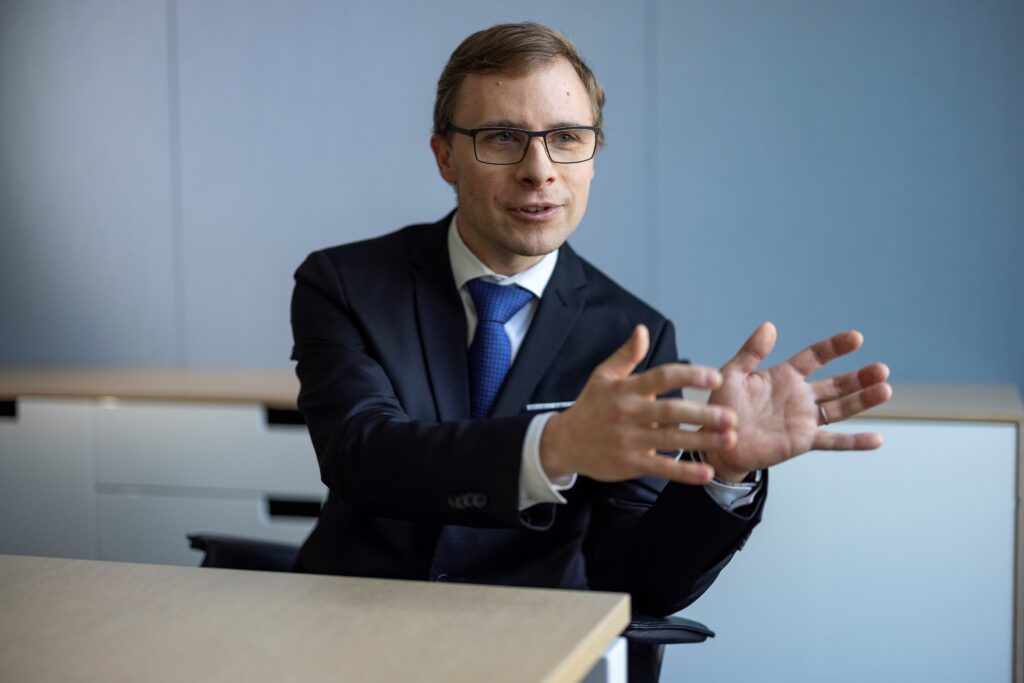
The European Union itself has shown the way through the strengthened action of the European Investment Bank (EIB). At a recent conference on private assets organised by the Association of the Luxembourg Fund Industry (ALFI), Andra Migiu, Head of Division, Security and Defence Office at the EIB, confirmed that the institution aims to reach around €3.5 billion in loans to the security and defence sector. The EIB, while not directly financing weapons production, is authorised to finance military infrastructure (roads, hospitals, cybersecurity centres), advanced technologies (radars, satellites, AI, aeronautics) – often dual-use – and SMEs in the sector, which often find it harder to secure funding. “Indeed, no link in the chain should be underestimated. The European defence industry is often associated with a few very big names (Airbus, Rheinmetall, Leonardo, Thales, BAE Systems, Safran…), but specialised SMEs often bring high-quality products to market,” confirms André Wilmes, President of Lux Defence, the association recently created to develop Luxembourg’s defence industry, which already boasts several flagship members.
“The European defence industry is often associated with a few very big names, but specialised SMEs often bring high-quality products to market.”

Defence Tech and venture capital
To capitalise on a once-in-a-generation investment window, the alternative investment firm based in Luxembourg, Ilavska Vuillermoz Capital (IVC), launched the Defence Tech Fund in May 2025. Its goal is to back companies developing cutting-edge technologies that strengthen democratic nations and enhance security resilience, according to Laurent Hengesch, co-founder and Managing Partner of the firm. “We look for visionary founders solving major defence or security problems with scalable, capital-efficient technologies,” he explains. This new fund focuses on unlisted companies because they are the true engine of innovation. “It’s particularly true in deeptech and defence, where agility and breakthrough potential outpace incumbents. By investing early, the fund can capture outsized value before these technologies reach mainstream defence procurement channels,” observes Hengesch.
Currently, it has invested in three young companies whose technologies aim to strengthen global security and stability: 5.0 Robotics (an Estonian company enabling the production of critical components in the field); Centinus (a U.S. drone operations platform enabling high-precision missions); and Aerobotics 7 (a U.S. start-up that has developed the first system capable of detecting, in real time, buried landmines and unexploded ordnance). “Investors value the opportunity to participate in technologies critical to national resilience and future security infrastructure,” notes the IVC founder.
“Investors value the opportunity to participate in technologies critical to national resilience and future security infrastructure.”

Broaden the scope of opportunities
Europe’s leading asset manager, France’s Amundi, also launched an ETF fund in May 2025 – Amundi Stoxx Europe Defence, domiciled in Luxembourg – as well as a fund on European strategic autonomy, of which defence is one of the five pillars. “During that first launch, two and a half years ago, investors asked us many questions about our exposure to the defence sector. This spring, for the ETF launch, we hardly received any,” notes Damien Mariette, Senior Fund Manager, Global Equities at CPR Asset Management, a subsidiary of Amundi.
Awareness of Europe’s need to rearm has now spread across the continent, and as long as one does not venture into the segment of weapons prohibited by international humanitarian law, investors follow. “It has become well known that the armaments sector is extremely regulated and complies with numerous international treaties. Its players are also constrained by export licences and cannot sell their products to just anyone,” continues Mariette.
“It has become well known that the armaments sector is extremely regulated and complies with numerous international treaties.”

Currently, European ESG regulations do not exclude the defence sector – except for controversial weapons. While awaiting a clearer stance, it is mainly the management companies themselves that make ESG choices regarding their funds.
From a technical standpoint, designing a defence fund appears no more complex than any other. The most pressing issue at present is the narrowness of the sector in terms of the number of listed players. Amundi’s recent ETF includes only 22 holdings, with the top eight accounting for 80% of the assets. The DWS ETF includes 28, making it the thematic ETF in the group with the fewest constituents. But in the current context, asset managers are betting on the arrival of new players – tech start-ups or traditional firms adding a defence division to their activities. “The European Union must absolutely catch up on R&D investment in the defence sector,” points out Olivier Souliac. “Patent data shows that catch up efforts would be needed on cybersecurity and drone technology.”
The defence sector is clearly the theme that has emerged this year and is beginning to attract investors – both those seeking returns and those wanting to give meaning to their investments. It marks a fairly radical shift in perspective, but one that has taken hold in an especially troubled geopolitical context. Opportunities are therefore beginning to flow in, appealing to different classes of investors. As this trend is here to stay for the long term, the range of companies should also expand – particularly through those focusing on dual-use applications. The taboo surrounding investment in defence, within the limits allowed by international treaties, is indeed beginning to erode.